Why Clear Communication Keeps Merchant Ship Crews Safe.
05 October, 2026· Article by Maria Jones


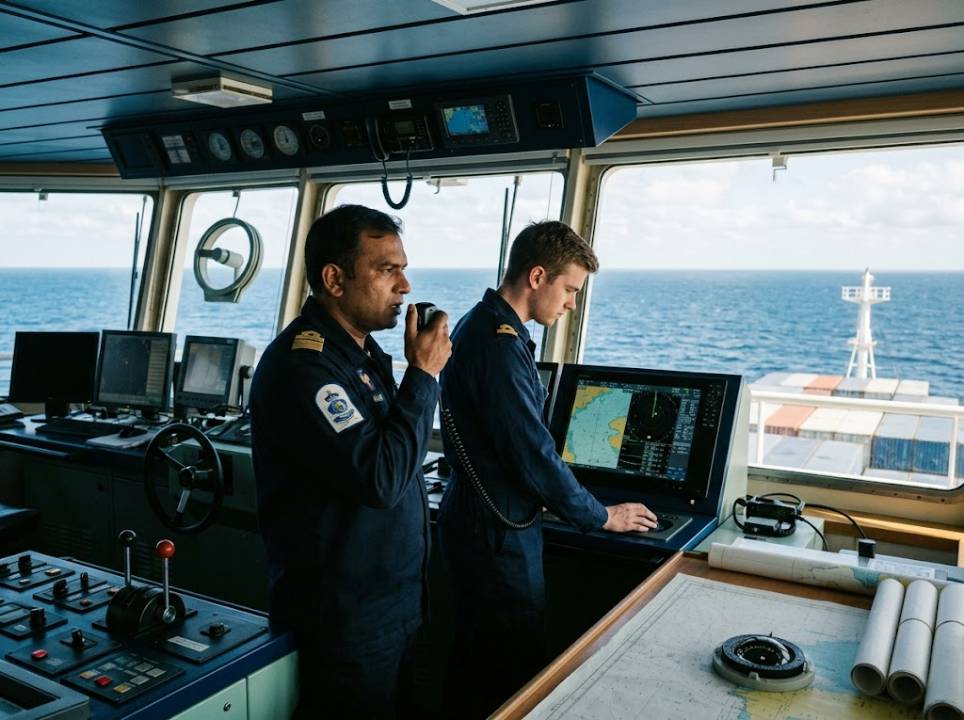
On a typical container ship crossing the Indian Ocean, the captain might be Croatian, the chief engineer Ukrainian, the officers Filipino and Indian, and the ratings from Myanmar or Indonesia. The ship could be owned in Greece, managed from Hamburg, flagged in Liberia and chartered by a Swiss trading house. Multinational crews are not the exception in merchant shipping. They are the rule.
That diversity is one of the industry's strengths. It is also a constant safety challenge, because when something goes wrong on a ship, everyone needs to understand the same instruction at the same moment.
English as the language of the sea
English is the working language of international shipping. The International Maritime Organization adopted the Standard Marine Communication Phrases in 2001 to give seafarers a simplified, standardised set of expressions for navigation, emergencies and ship-to-shore communication. Phrases like "I require tug assistance" or "Fire on board" are designed to be unambiguous, even over a crackling VHF radio.
The STCW Convention, which sets training standards for seafarers worldwide, requires deck officers to have adequate knowledge of English. In practice, proficiency varies widely, and stress, fatigue and accents can make even simple messages hard to follow.
When language contributes to accidents
Accident investigations regularly mention communication breakdowns. Pilots and bridge teams misunderstand each other during harbour approaches. Engine room crews misread written procedures. Safety drills are conducted in a language some crew members barely understand, so the drill is carried out mechanically rather than learned.
Researchers studying maritime accidents have long noted that human factors play a role in the large majority of incidents, and communication is one of the most frequently cited of those factors. A misunderstood instruction during a mooring operation can cost a crew member a hand, or worse.
Crews from Russian- and Ukrainian-speaking countries
For decades, Russia and Ukraine have been among the world's major suppliers of maritime officers and engineers. Ukrainian seafarers in particular are highly respected for their technical training, and many serve on European-managed fleets. Since 2022, the war has disrupted crew changes, certification and travel, forcing ship managers to adapt quickly.
Crew documents, medical certificates, training records and employment contracts for these seafarers often exist in Russian or Ukrainian. Ship managers and P&I clubs handling claims, injuries or disputes rely on professional russian english translation to review evidence accurately. In the same way, accurate ukrainian english translation is needed for certificates of competency, seaman's books and family documents when crew members need support ashore.
Manuals and procedures
Modern ships carry thousands of pages of documentation: safety management systems, equipment manuals, maintenance procedures and company policies. Much of it is written in English, but large parts originate with equipment makers in Germany, Norway, Japan, South Korea and China.
German manufacturers supply engines, pumps, cranes and navigation systems to fleets worldwide. Their technical documentation and service bulletins are often first written in German. Shipyards and ship managers commissioning or maintaining that equipment frequently use specialist german translation services to make sure technical terms, torque values and safety warnings come across precisely in English.
What fleets are doing
Responsible ship managers are tackling the problem from several angles:
- Regular English language assessments for officers and ratings, with targeted training.
- Simplified, illustrated procedures for critical tasks such as enclosed-space entry.
- Bilingual safety signage on ships with a dominant crew nationality.
- Closed-loop communication on the bridge, where every order is repeated back.
- E-learning platforms with courses available in several languages.
Crew welfare and isolation
Language also affects wellbeing. Seafarers spend months away from home, often with only a handful of colleagues who share their native language. Loneliness and mental health problems are a growing concern in the industry. Welfare organisations and port chaplaincies increasingly offer support in multiple languages, and some shipping companies provide counselling services that crew can access in their own language.
Technology helps, with limits
Real-time translation apps and AI tools are starting to appear on ships, mainly for informal communication and welfare. They can help bridge everyday gaps, but they are not a substitute for standard phrases and trained communication in emergencies. Connectivity at sea is also uneven, although satellite internet has improved dramatically in recent years.
Pilots, ports and shore staff
Communication challenges do not stop at the ship's rail. Harbour pilots, tug crews, port state control inspectors and terminal staff all interact with multinational crews, often under time pressure. A pilot boarding in Rotterdam, Santos or Busan may speak excellent English with a strong local accent, while the officer of the watch has learned English mainly from textbooks. Many ports now train their pilots and vessel traffic service operators specifically in Standard Marine Communication Phrases, and some run joint exercises with visiting crews. Shore-based ship managers also play a role by writing clear, simple circulars rather than dense corporate language that crews struggle to interpret.
Effective multilingual communication on ships goes beyond standard phrases and relies on professional language support for complex situations. When crew changes, safety investigations or medical emergencies involve multiple nationalities, having trained interpreters available ensures critical information is understood accurately by everyone. Remote interpreting services allow shore-based language specialists to support vessels at sea during incidents or inspections. Investing in professional multilingual communication capabilities is becoming as important to maritime safety as the technical training itself.
Looking ahead
The shipping industry faces major changes, from decarbonisation and new fuels such as ammonia and methanol to automation and remote operations. Each new technology brings new procedures and training, and with them new communication challenges. Crews handling toxic or flammable fuels will need absolutely clear instructions.
Safe shipping has always depended on good seamanship. In a global industry, good seamanship increasingly includes good communication.
On a typical container ship crossing the Indian Ocean, the captain might be Croatian, the chief engineer Ukrainian, the officers Filipino and Indian, and the ratings from Myanmar or Indonesia. The ship could be owned in Greece, managed from Hamburg, flagged in Liberia and chartered by a Swiss trading house. Multinational crews are not the exception in merchant shipping. They are the rule.
On a typical container ship crossing the Indian Ocean, the captain might be Croatian, the chief engineer Ukrainian, the officers Filipino and Indian, and the ratings from Myanmar or Indonesia. The ship could be owned in Greece, managed from Hamburg, flagged in Liberia and chartered by a Swiss trading house. Multinational crews are not the exception in merchant shipping. They are the rule.
That diversity is one of the industry's strengths. It is also a constant safety challenge, because when something goes wrong on a ship, everyone needs to understand the same instruction at the same moment.
That diversity is one of the industry's strengths. It is also a constant safety challenge, because when something goes wrong on a ship, everyone needs to understand the same instruction at the same moment.
English as the language of the sea
English is the working language of international shipping. The International Maritime Organization adopted the Standard Marine Communication Phrases in 2001 to give seafarers a simplified, standardised set of expressions for navigation, emergencies and ship-to-shore communication. Phrases like "I require tug assistance" or "Fire on board" are designed to be unambiguous, even over a crackling VHF radio.
English is the working language of international shipping. The International Maritime Organization adopted the Standard Marine Communication Phrases in 2001 to give seafarers a simplified, standardised set of expressions for navigation, emergencies and ship-to-shore communication. Phrases like "I require tug assistance" or "Fire on board" are designed to be unambiguous, even over a crackling VHF radio.
The STCW Convention, which sets training standards for seafarers worldwide, requires deck officers to have adequate knowledge of English. In practice, proficiency varies widely, and stress, fatigue and accents can make even simple messages hard to follow.
The STCW Convention, which sets training standards for seafarers worldwide, requires deck officers to have adequate knowledge of English. In practice, proficiency varies widely, and stress, fatigue and accents can make even simple messages hard to follow.
When language contributes to accidents
Accident investigations regularly mention communication breakdowns. Pilots and bridge teams misunderstand each other during harbour approaches. Engine room crews misread written procedures. Safety drills are conducted in a language some crew members barely understand, so the drill is carried out mechanically rather than learned.
Accident investigations regularly mention communication breakdowns. Pilots and bridge teams misunderstand each other during harbour approaches. Engine room crews misread written procedures. Safety drills are conducted in a language some crew members barely understand, so the drill is carried out mechanically rather than learned.
Researchers studying maritime accidents have long noted that human factors play a role in the large majority of incidents, and communication is one of the most frequently cited of those factors. A misunderstood instruction during a mooring operation can cost a crew member a hand, or worse.
Researchers studying maritime accidents have long noted that human factors play a role in the large majority of incidents, and communication is one of the most frequently cited of those factors. A misunderstood instruction during a mooring operation can cost a crew member a hand, or worse.
Crews from Russian- and Ukrainian-speaking countries
For decades, Russia and Ukraine have been among the world's major suppliers of maritime officers and engineers. Ukrainian seafarers in particular are highly respected for their technical training, and many serve on European-managed fleets. Since 2022, the war has disrupted crew changes, certification and travel, forcing ship managers to adapt quickly.
For decades, Russia and Ukraine have been among the world's major suppliers of maritime officers and engineers. Ukrainian seafarers in particular are highly respected for their technical training, and many serve on European-managed fleets. Since 2022, the war has disrupted crew changes, certification and travel, forcing ship managers to adapt quickly.
Crew documents, medical certificates, training records and employment contracts for these seafarers often exist in Russian or Ukrainian. Ship managers and P&I clubs handling claims, injuries or disputes rely on professional russian english translation to review evidence accurately. In the same way, accurate ukrainian english translation is needed for certificates of competency, seaman's books and family documents when crew members need support ashore.
Crew documents, medical certificates, training records and employment contracts for these seafarers often exist in Russian or Ukrainian. Ship managers and P&I clubs handling claims, injuries or disputes rely on professional russian english translation to review evidence accurately. In the same way, accurate ukrainian english translation is needed for certificates of competency, seaman's books and family documents when crew members need support ashore.
Manuals and procedures
Modern ships carry thousands of pages of documentation: safety management systems, equipment manuals, maintenance procedures and company policies. Much of it is written in English, but large parts originate with equipment makers in Germany, Norway, Japan, South Korea and China.
Modern ships carry thousands of pages of documentation: safety management systems, equipment manuals, maintenance procedures and company policies. Much of it is written in English, but large parts originate with equipment makers in Germany, Norway, Japan, South Korea and China.
German manufacturers supply engines, pumps, cranes and navigation systems to fleets worldwide. Their technical documentation and service bulletins are often first written in German. Shipyards and ship managers commissioning or maintaining that equipment frequently use specialist german translation services to make sure technical terms, torque values and safety warnings come across precisely in English.
German manufacturers supply engines, pumps, cranes and navigation systems to fleets worldwide. Their technical documentation and service bulletins are often first written in German. Shipyards and ship managers commissioning or maintaining that equipment frequently use specialist german translation services to make sure technical terms, torque values and safety warnings come across precisely in English.
What fleets are doing
Responsible ship managers are tackling the problem from several angles:
- Regular English language assessments for officers and ratings, with targeted training.
- Simplified, illustrated procedures for critical tasks such as enclosed-space entry.
- Bilingual safety signage on ships with a dominant crew nationality.
- Closed-loop communication on the bridge, where every order is repeated back.
- E-learning platforms with courses available in several languages.
Crew welfare and isolation
Language also affects wellbeing. Seafarers spend months away from home, often with only a handful of colleagues who share their native language. Loneliness and mental health problems are a growing concern in the industry. Welfare organisations and port chaplaincies increasingly offer support in multiple languages, and some shipping companies provide counselling services that crew can access in their own language.
Language also affects wellbeing. Seafarers spend months away from home, often with only a handful of colleagues who share their native language. Loneliness and mental health problems are a growing concern in the industry. Welfare organisations and port chaplaincies increasingly offer support in multiple languages, and some shipping companies provide counselling services that crew can access in their own language.
Technology helps, with limits
Real-time translation apps and AI tools are starting to appear on ships, mainly for informal communication and welfare. They can help bridge everyday gaps, but they are not a substitute for standard phrases and trained communication in emergencies. Connectivity at sea is also uneven, although satellite internet has improved dramatically in recent years.
Real-time translation apps and AI tools are starting to appear on ships, mainly for informal communication and welfare. They can help bridge everyday gaps, but they are not a substitute for standard phrases and trained communication in emergencies. Connectivity at sea is also uneven, although satellite internet has improved dramatically in recent years.
Pilots, ports and shore staff
Communication challenges do not stop at the ship's rail. Harbour pilots, tug crews, port state control inspectors and terminal staff all interact with multinational crews, often under time pressure. A pilot boarding in Rotterdam, Santos or Busan may speak excellent English with a strong local accent, while the officer of the watch has learned English mainly from textbooks. Many ports now train their pilots and vessel traffic service operators specifically in Standard Marine Communication Phrases, and some run joint exercises with visiting crews. Shore-based ship managers also play a role by writing clear, simple circulars rather than dense corporate language that crews struggle to interpret.
Communication challenges do not stop at the ship's rail. Harbour pilots, tug crews, port state control inspectors and terminal staff all interact with multinational crews, often under time pressure. A pilot boarding in Rotterdam, Santos or Busan may speak excellent English with a strong local accent, while the officer of the watch has learned English mainly from textbooks. Many ports now train their pilots and vessel traffic service operators specifically in Standard Marine Communication Phrases, and some run joint exercises with visiting crews. Shore-based ship managers also play a role by writing clear, simple circulars rather than dense corporate language that crews struggle to interpret.
Looking ahead
The shipping industry faces major changes, from decarbonisation and new fuels such as ammonia and methanol to automation and remote operations. Each new technology brings new procedures and training, and with them new communication challenges. Crews handling toxic or flammable fuels will need absolutely clear instructions.
The shipping industry faces major changes, from decarbonisation and new fuels such as ammonia and methanol to automation and remote operations. Each new technology brings new procedures and training, and with them new communication challenges. Crews handling toxic or flammable fuels will need absolutely clear instructions.
Safe shipping has always depended on good seamanship. In a global industry, good seamanship increasingly includes good communication.
Recent Posts
Der Hamburger Hafen zwischen K...
Le transport maritime face au ...
How a Container Ship Works: In...

Notizie Navi Che Muovono Il Co...

Actualites Navires Qui Influen...

Why the Marine Industry Is Ent...
Share it.

Links
We use cookies
We use cookies to give you the best online experience, remember your preferences, and understand how the site is used. You can accept all cookies, reject optional ones, or choose which categories to allow.
Privacy PolicyCookie preferences
Choose which cookies we can use. Necessary cookies stay on because the site cannot work without them.
For more details, read our Privacy Policy.